This banned books list looks at graphic novels and memoirs that have been pulled, restricted, or fought over in libraries and schools, with the real story behind each ban, sourced from library associations, publishers and the creators themselves.
That visual element has made graphic novels and memoirs disproportionately likely to end up on challenge lists in recent years, even when the content, panel for panel, mirrors what’s already been said in prose elsewhere on the shelf.
If you’re after a banned graphic novels list for Banned Books Week, or you’re curious about why comics get banned more than novels, here’s a great starting point.
Disclaimer: This post contains affiliate links and as an Amazon Associate, I earn from qualifying purchases. This means I earn a small commission if you choose to make a purchase using a link, but at no cost to you. I’ve included Amazon links to each recommended book as well as Bookshop.org (US and UK) where available.
A REBEL’S READING CHALLENGE
Banned Books Journal
Discover 100 banned books from around the world, then read them yourself and write down your thoughts.
1. Maus – Art Spiegelman (1986)
Spiegelman interviews his father about surviving the Holocaust, depicting Jewish characters as mice and Nazis as cats in a landmark graphic memoir.
Why it Was Banned
In January 2022, Tennessee’s McMinn County School Board voted unanimously to remove the Pulitzer Prize-winning graphic novel from its eighth-grade curriculum, citing profanity and a single image of nudity.
Spiegelman called the decision “Orwellian,” and comic shop owners around the country responded by offering free copies to any student in the district who wanted one.
About the Author
Art Spiegelman (born 1948) is an American cartoonist whose father survived Auschwitz, and whose own graphic memoir became the first of its kind to win a Pulitzer Prize.
Read Next: This book also appears in this list of banned books from around the world.
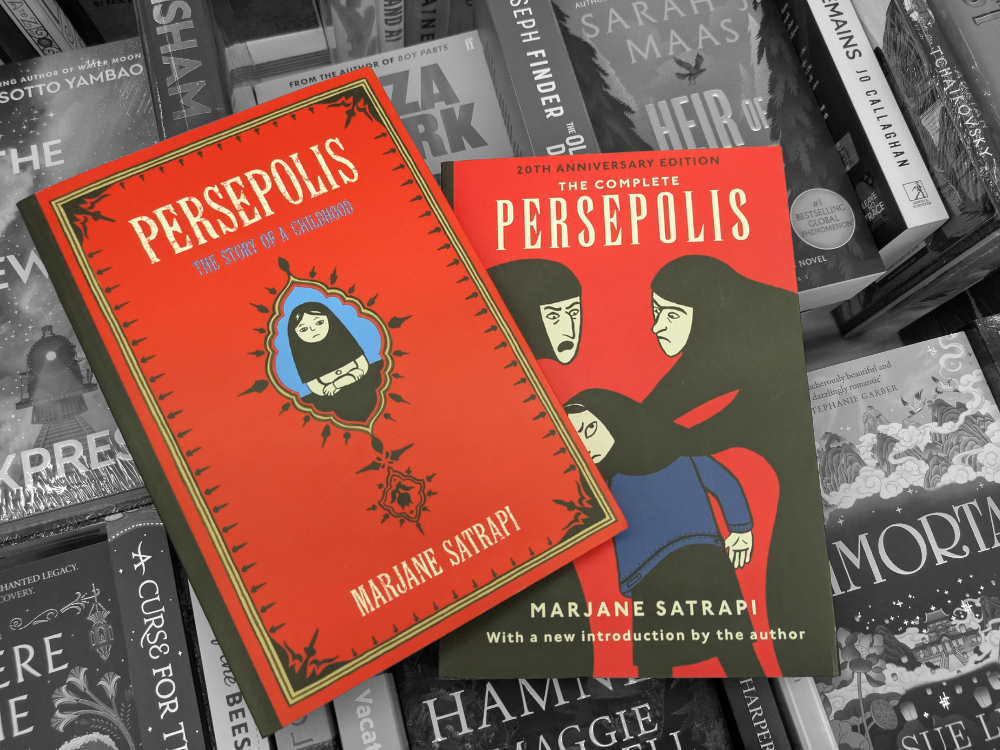
2. Persepolis – Marjane Satrapi (2000)
This autobiographical graphic memoir follows Satrapi’s childhood in Tehran during the Islamic Revolution and the Iran–Iraq War.’
I had never read a graphic novel before Persepolis and really enjoyed the medium, especially as the protagonist, the author herself, is a young girl; the comic-strip sequences feel youthful and fit the perspective. I highly recommend getting Part I and Part 2 (where Satrapi returns to Iran as an adult) together.
This book also appears in my list of Banned Books by Women Writers and Banned Books Around the World.
Why it Was Banned
The book and its 2007 film adaptation are banned in Iran itself over their critical depiction of the regime, while Chicago Public Schools separately pulled the memoir from classrooms in 2013 over a single panel depicting torture.
About the Author
Marjane Satrapi (1969-2026) was an Iranian-French graphic novelist and filmmaker whose memoir has become one of the most widely taught works of graphic nonfiction in American schools.
Read Next: Iran was our Nomad Book Club pick for April 2026. Check out the recommend list of Books About Iran to Understand Everyday Life here.
3. Gender Queer: A Memoir – Maia Kobabe (2019)
This autobiographical graphic novel traces Kobabe’s journey to understanding eir identity as nonbinary and asexual, using comic-strip storytelling to depict experiences of gender confusion, discovery and eventual self-acceptance.
Why it Was Banned
Gender Queer was the single most banned book in American school districts from mid-2021 to the end of 2022 and has topped the ALA’s most-challenged list for two consecutive years.
Objections centre on its depictions of sex, though the book carries an 18+ rating from its own publisher.
About the Author
Maia Kobabe is an American cartoonist and author who identifies as nonbinary and asexual and uses e/em/eir pronouns.
Read Next: The book also appears in this list of Banned Books by Queer Writers.
4. Fun Home – Alison Bechdel (2006)
Bechdel’s graphic memoir traces her childhood in a Pennsylvania funeral home, her closeted, ultimately suicidal father, and her own coming out as a lesbian while at college.
Why it Was Banned
The book was pulled from Missouri’s Marshall Public Library for five months after its 2006 publication.
It also faced a far larger fight in 2014 when the South Carolina legislature moved to cut $52,000 from the College of Charleston’s budget — the exact cost of the summer reading programme that had assigned the book to freshmen.
A state representative said the memoir “graphically shows lesbian acts” and didn’t merit academic study; the funding was ultimately restored after national outcry.
About the Author
Alison Bechdel (born 1960) is an American cartoonist, best known before Fun Home for her long-running comic strip Dykes to Watch Out For, who went on to win a MacArthur “Genius Grant” in 2014.
5. Blankets – Craig Thompson (2003)
Thompson’s autobiographical graphic novel follows his conservative Christian upbringing in rural Wisconsin, childhood sexual abuse, and his first love as a teenager at a church winter camp.
Why it Was Banned
Blankets was removed from the same Marshall, Missouri public library as Fun Home in 2006, in a joint controversy that drew national attention to both books.
At 592 pages, it remains one of the longest graphic novels ever published, and one of the most acclaimed memoirs about growing up religious in America.
About the Author
Craig Thompson (born 1975) is an American cartoonist whose graphic memoirs and travelogues are known for their loose, expressive brushwork.
6. Drama – Raina Telgemeier (2012)
Callie, a middle schooler who loves theatre but can’t sing, works as her school play’s stage designer while navigating crushes, friendship and two gay twin brothers in the cast.
Why it Was Banned
Despite containing no profanity, drugs or sexual content, Drama has appeared on the ALA’s Top Ten Most Challenged Books list four times between 2014 and 2019, driven almost entirely by objections to a single panel showing two boys sharing a brief kiss onstage.
Telgemeier has pointed out that a heterosexual kiss in the same scene would likely never have been challenged at all.
About the Author
Raina Telgemeier is an American cartoonist and one of the bestselling graphic novelists in the children’s and middle-grade market, known also for Smile and Sisters.
7. Flamer – Mike Curato (2020)
Aiden, a queer, biracial fourteen-year-old, spends his last week at Boy Scout summer camp confronting bullying, faith, body image and his growing feelings for a fellow camper.
Why it Was Banned
Flamer tied with Gender Queer as the most banned book in America during the autumn of 2022, and was singled out by name by Florida’s governor.
The graphic novel is semi-autobiographical, and Curato has written that he included the character’s darkest moment specifically so other queer teenagers who’d felt the same way would know they weren’t alone.
About the Author
Mike Curato is an American author and illustrator, previously known for the children’s picture book series Little Elliot, before writing this semi-autobiographical debut graphic novel for teenagers.
8. New Kid – Jerry Craft (2019)
Jordan Banks, a Black seventh-grader from Washington Heights, navigates his first year at a mostly white, wealthy private school in the first graphic novel ever to win the Newbery Medal.
Why it Was Banned
In October 2021, Texas’s Katy Independent School District pulled New Kid and its sequel from shelves and postponed Craft’s scheduled virtual visit, after 400 parents signed a petition claiming the book promoted critical race theory.
Craft said he had to look up the term himself, since the book, loosely based on his own childhood, contains no academic theory of any kind.
The book was reinstated ten days later after a review found no inappropriate content.
About the Author
Jerry Craft is an American cartoonist and one of only five Black authors to win the Newbery Medal, awarded in 2020 for New Kid.
9. American Born Chinese – Gene Luen Yang (2006)
Three interwoven stories — a Chinese-American schoolboy, the legendary Monkey King, and a grotesque stereotype named Chin-Kee — collide in a graphic novel about identity, shame and assimilation.
Why it Was Banned
The graphic novel was one of more than a dozen books removed or suspended by Texas’s Leander Independent School District in 2021, in a review that followed a single parent’s complaint and disproportionately affected books by or about people of colour.
Yang, along with dozens of other authors including Margaret Atwood and Laurie Halse Anderson, signed an open letter calling on the district to reverse the removals.
About the Author
Gene Luen Yang is an American cartoonist and former Library of Congress National Ambassador for Young People’s Literature, whose graphic novel was the first ever to be a National Book Award finalist.
10. Kiss Number 8 – Colleen AF Venable and Ellen T. Crenshaw (2019)
Amanda, a Catholic school student and dedicated baseball fan, has her sense of self upended after discovering a long-held family secret, while quietly realising she’s falling for her best friend.
Why it Was Banned
Kiss Number 8 was among the titles suspended by Texas’s Leander Independent School District in the same 2021 review that hit American Born Chinese, prompting illustrator Ellen T. Crenshaw and writer Colleen AF Venable to join dozens of authors in a joint open letter to the district.
The graphic novel’s coming-out narrative has drawn similar objections in several other US school districts since.
About the Authors
Colleen AF Venable is an American writer and Ellen T. Crenshaw an American illustrator, whose graphic novel collaboration won a Stonewall Honor for its depiction of queer teenage identity.
11. This One Summer – Mariko Tamaki and Jillian Tamaki (2014)
Two teenage girls, Rose and Windy, spend their annual summer holiday at a lake house, navigating the messy, uncomfortable transition out of childhood while the adults around them deal with crises of their own.
Why it Was Banned
The graphic novel topped the ALA’s list of most challenged books in both 2016 and 2018, cited for mature themes, drug use, and profanity, despite winning a Caldecott Honor — an award typically reserved for children’s picture books.
About the Authors
Mariko Tamaki (born 1975) and Jillian Tamaki (born 1980) are Canadian cousins and long-time collaborators whose graphic novels frequently centre the interior lives of teenage girls.
Read Next: The book also appears in this list of Banned YA Books.
12. Barefoot Gen – Keiji Nakazawa
This autobiographical manga follows a young boy’s survival of the atomic bombing of Hiroshima and its brutal aftermath, drawn from the author’s own childhood experience.
Why it Was Banned
The manga was removed from elementary and junior high schools in Matsue City, Japan, over its graphic depictions of the bombing’s aftermath.
Some critics have also called for its removal over its unflinching portrayal of wartime Japan itself, arguing the book paints an unflattering picture of the era.
About the Author
Keiji Nakazawa (1939–2012) was a Japanese manga artist and Hiroshima survivor who began writing about the bombing directly after his mother’s death, when he discovered her bones had been eaten away by radiation.
Literary Retreats
Join us on our next reading retreat and explore literary travel destinations with a group of like-minded book lovers.
More Banned Graphic Novels
Several of these creators have pointed out the same double standard: a chaste same-sex kiss draws complaints that a chaste heterosexual one never would, and a single frame of historical violence gets a Pulitzer winner pulled from classrooms entirely.
Do you have more to add to this list? Let me know in the comments below.
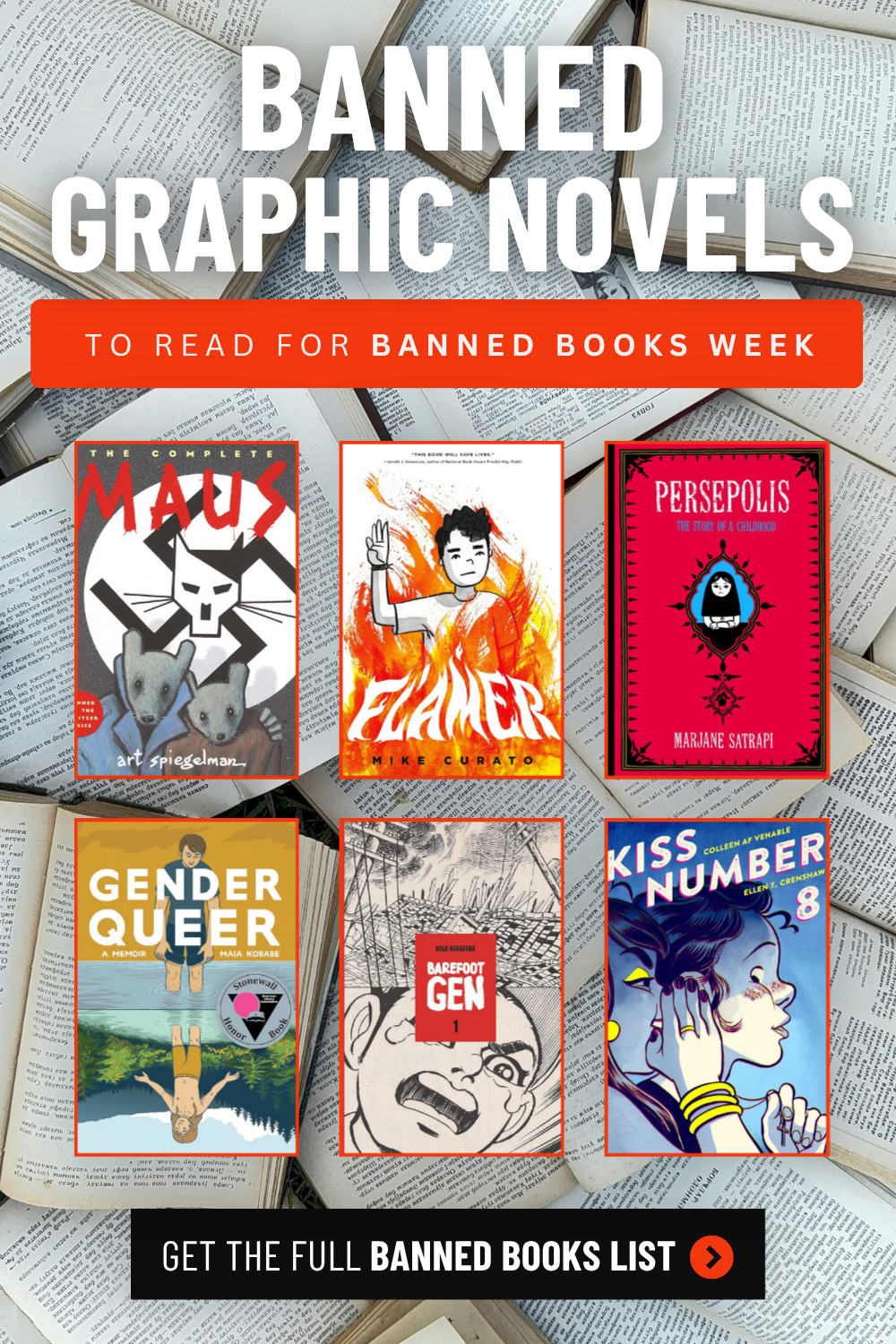
Pin this post for later:
Fantastic Books & Where to Find Them
For more of what to read where, check out my full Travel Books Guide, filled with book recommendations for different destinations, the most beautiful bookstores around the world, tips on how to get the best deals on audiobooks and e-books, as well as more literary travel.
Travel Essentials
Here are the websites and services I personally use and recommend.
FLIGHTS: The best deals can be found on Skyscanner, Google Flights and Kiwi (learn more about Kiwi travel hacking here).
TRAVEL INSURANCE: I recommend World Nomads for travel insurance because you can purchase once you’re already overseas and you can easily extend your policy. For digital nomads, I recommend and personally use Genki (learn more about Genki digital nomad health insurance here).
E-SIM: For travel in Europe, I use an e-sim with GoMobile, which is a provider based in Malta, but you need to be there to set it up.
ACCOMMODATION: I use Booking.com for hotels and Airbnb for apartments. For Colivings, I usually book privately, but Coliving.com is a good place to start.
THINGS TO DO: I use Viator or Get Your Guide for booking day trips, city tours and other activities, though I often check reviews on TripAdvisor too.
